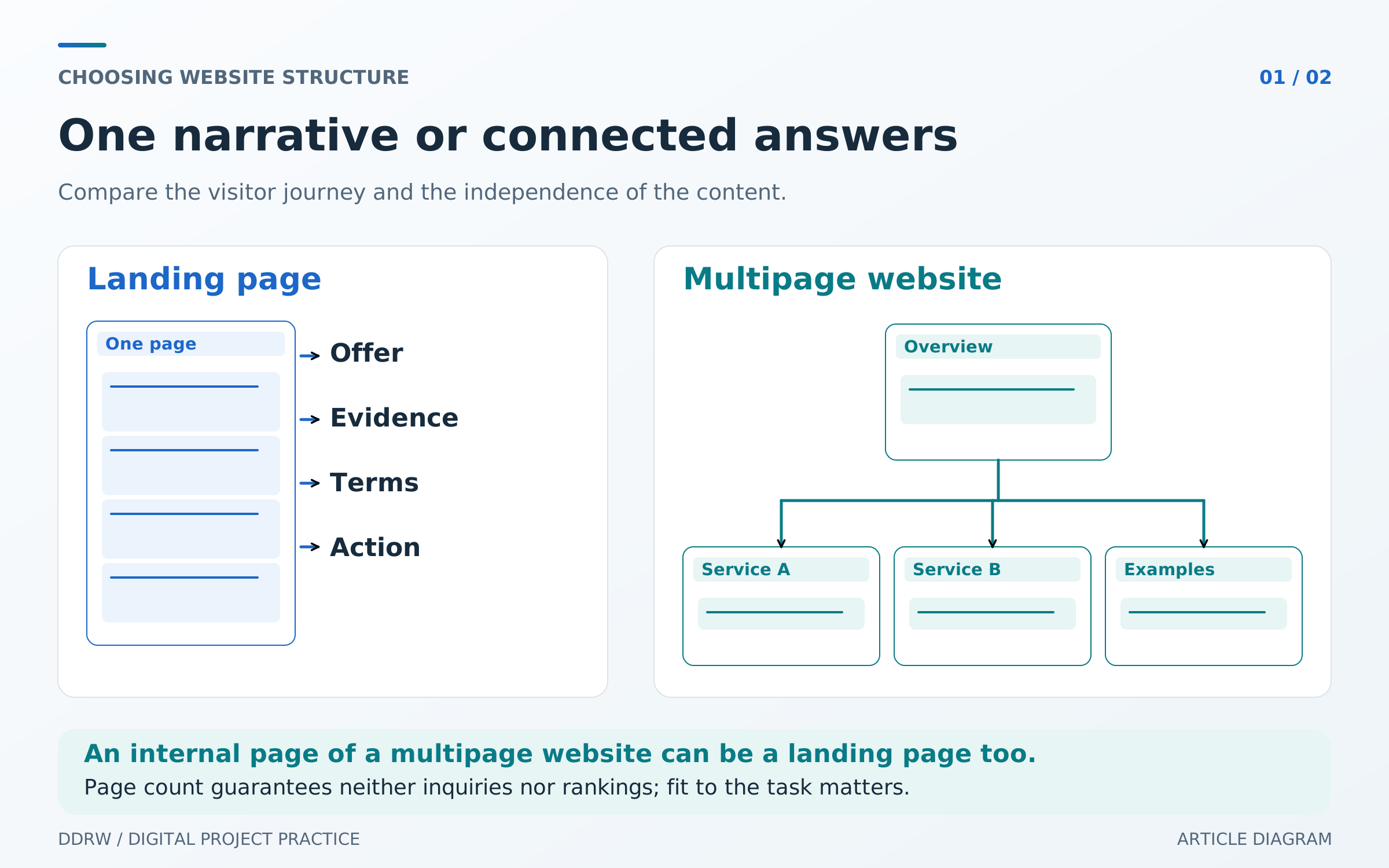
A landing page suits a situation where visitors need a sequential explanation of one offer leading to a clear action. A multipage website is more useful when people need different services, detailed comparisons, work examples and materials they will return to. The choice depends on how visitors' tasks differ and what content each requires.
A landing page is still a website. Comparing formats usually means comparing one main page with a sequential narrative against a website with several independent pages. Neither option guarantees inquiries or high search rankings by itself.
How landing pages, brochure sites and multipage websites differ
A one-page landing site brings an offer into a single journey: what clients receive, how it works, what supports the promise and how to take the next step. Visitors may jump to a block through the menu but remain within one main page.
A brochure website primarily introduces a company or professional. It may describe their activities, show a few examples and provide contacts. It can be one page or several. The distinction from a landing page is therefore about purpose: briefly presenting a business and explaining a specific offer in detail are different tasks.
A multipage website gives independent subjects their own addresses: services, projects, company information and articles. Someone can arrive directly at an internal page and receive an answer without having to read the homepage. Navigation connects related questions.
The term “landing page” is broader than “one-page website.” In advertising, it is the page an advertisement links to; that can be an internal service page. Google Ads uses this definition. A multipage website can include several pages structured as landing pages.
When one main page is enough
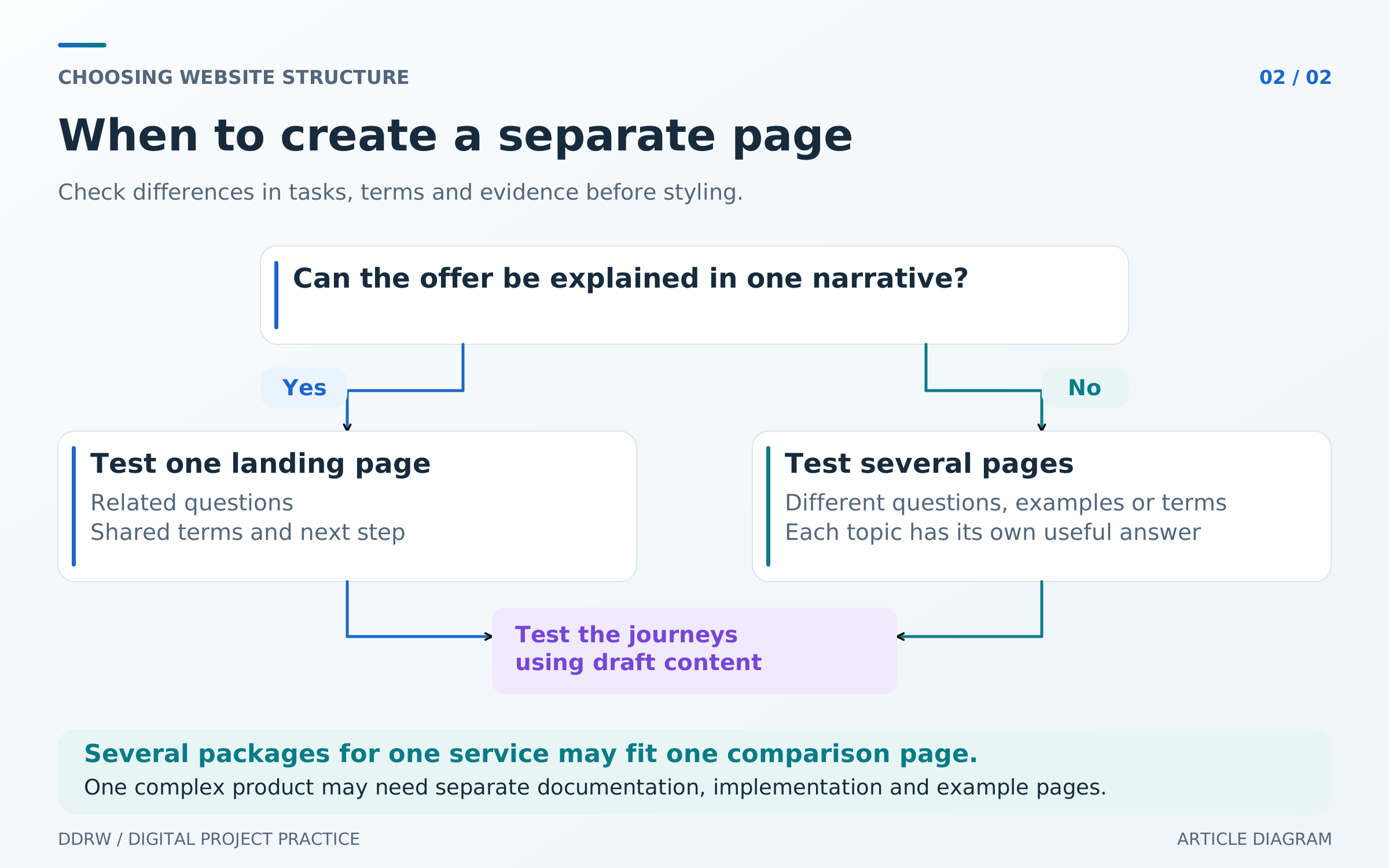
Consider a landing page if the offer can be explained clearly in one narrative. Visitors have similar questions, need roughly the same evidence and share one main next step: for example, discussing a particular service or registering for an event.
Several versions of one service do not necessarily need separate pages. If only package size or optional extras differ, compare them within one section. Choosing becomes easier when terms sit together rather than requiring movement between nearly identical descriptions.
A landing page also suits a limited campaign with a known offer and traffic source. However, campaign duration alone does not determine the format: even a single launch of a complex product may need documentation, examples and answers for different participants in the purchase.
Judge whether one page is sufficient by its content. If all the main information supports one buyer decision, a sequential presentation is appropriate. If much of the page needs qualifications such as “for another type of client, see below,” consider splitting it.
A privacy policy or other utility documents do not change the main way the offer is presented. Commercial structure and the visitor journey matter more than formally counting every URL.
When independent pages are needed
Multiple pages help when different offerings require different explanations. Their audiences, working terms, selection criteria, examples and next actions may differ. The shared page then remains an overview, with detail at separate addresses.
Consider a hypothetical cleaning company. Recurring office cleaning, post-renovation cleaning and warehouse work may require different initial information and examples. If those differences are substantial, investigate them as candidates for separate pages. This illustrates selection logic, not a universal recommendation for every company in that industry.
The reverse is also possible: a company sells one product, but buyers investigate it from different perspectives. Some need compatibility information, others an implementation process, and others detailed documentation. Having one product does not require a one-page site.
A multipage structure distributes this material and gives each reader a suitable entry point. Visitors still need to understand how the pages relate: where the overview is, where the detail is and where to ask a question.
Our breakdown of the ANTA website shows how separate offerings are organized in a real service catalog. The structural principle is that a separate page should serve a meaningful content task that is awkward within the overall narrative.
Connect website format to advertising
For advertising traffic, matching the page to the advertisement's promise matters more than the website's page count. Someone who clicked a specific offer needs to find its terms quickly. Sending them to a general overview can add unnecessary searching even when the website describes the company thoroughly.
Google Ads recommends aligning landing-page content with advertisements and queries, as described in its guide to ads and landing pages. The practical implication for structure is that each substantially different advertising task needs a suitable entry page.
Multiple campaigns do not automatically require multiple websites. They can lead to different services under one domain or to one page when the offer and visitors' expectations match. Build a separate landing page after checking those differences.
Do not assume in advance that a landing page converts better. Outcomes depend on the offer, audience, display conditions and content. Compare options under comparable conditions using the chosen target action, rather than a reputation for being a “selling” format.
What changes for search
One page can answer related questions on a narrow subject. Limits arise when it is made to cover several independent offerings with different conditions and arguments. Readers then struggle to find the relevant part, and the content loses focus.
Separate pages let you explain different tasks thoroughly at clear addresses. More URLs do not, by themselves, make a website more useful. If pages differ only in keywords and repeat their content, they do not provide independent answers.
Yandex recommends a clear structure, unique addresses and ordinary links between pages. These principles appear in its Webmaster site-structure guidance. They help organize content access; rankings cannot be promised solely on the basis of format.
A menu linking to sections of one page does not turn it into several independent documents either. Google specifically advises against using URL fragments to substitute distinct content. Google's URL guidance. An anchor is appropriate for jumping to a page section, but a separate service with its own content is a candidate for its own URL.
Before design, match query groups to real offers and available materials. If a topic has only a new title and no separate answer, another page is premature.
Choose the structure before visual design
Make a short map: what question brings the person here, which offer fits, and what they need to know before contacting you. For each group, compare content, evidence and next steps with the other groups. This reveals where a block is enough and where a page is needed.
| Situation | Option to test | What should support the choice |
|---|---|---|
One offer and similar visitor questions | One landing page | The main narrative supports a single decision |
Several packages for one service | A shared comparison page | Differences are clear without separate detailed descriptions |
Several offerings with different terms and examples | An overview and individual offering pages | Each page provides an independent, useful answer |
A complex product with documentation and different buyer tasks | Several connected sections | Readers can obtain the required details separately |
A company and a separate advertising promotion | The main website and a promotion page | Promotion terms are clear and the connection to the company remains |
Then test three journeys: a person discovering the business, arriving for a specific offer and returning for details. Each journey should make the relevant information easy to find. If all three fit comfortably on one page, complex navigation may be unnecessary.
A page map and draft content are enough at this stage. Our article “Preparing a website brief for a clear estimate” covers project preparation in more detail. Checking structure before styling avoids spending time on pages whose purpose remains undefined.
Moving from a landing page to several pages
Start by separating functions. Keep the overall offer and overview on the homepage, and move detailed offerings to their own addresses. The advertising landing page can remain if it still serves a specific task.
Give new pages their own terms, examples and answers. Simply copying blocks and changing headings does not explain why visitors should move between sections. Update menus and links too, so important pages are accessible from appropriate places.
If existing URLs change, decide in advance where old links and advertisements should lead. Check links and redirects after migration. Retain working addresses where they fit the new structure; changing the number of pages does not automatically require a new domain.
Expansion depends on the platform and current website structure. Sometimes adding pages in the existing system is enough; sometimes templates and content management need reworking. A promise to “make a landing page first and easily expand later” therefore needs clarification through a concrete future scope.
One page is not always cheaper than a small multipage website: design, content and functionality can vary. Budget questions are covered in our article on corporate website costs. When comparing formats, agree tasks and content first, then estimate implementation.
What to discuss with DDRW
To choose a format, identify your offers, differences between visitors, main traffic sources and sections needed for near-term growth. Specify which information is ready and who will update it after launch.
Our Business websites service offers a place to discuss a structure for these tasks. The outcome should be a clear first-release scope: main pages, each page's purpose and the boundaries of later expansion.
Landing pages and multipage sites can work together. Choose a set of pages that helps a particular visitor find an answer and take the next step. Send your task to DDRW to compare that set with available materials and the development scope.