October 30, 2026. Primary sources checked at 00:45 Moscow time.
Tether CEO Paolo Ardoino reported freezing more than 1.567 billion USDT linked to a possible Binance hack. The exchange itself said it was investigating reports of a potential security issue and assured users their funds were safe. The checked statements did not disclose the final causes of the incident or the extent of any possible losses.
What Tether’s CEO reported
In a post on his official account, Ardoino connected the USDT freeze with an alleged Binance hack. He used the wording potential Binance exchange hack: he was discussing a possible hack rather than presenting a completed technical report.
This clarifies the initial news of “more than $1.5 billion”: the primary source specified more than 1.567 billion USDT tokens. The amount frozen cannot automatically be called an exchange or customer loss. That conclusion would require data on affected addresses, asset ownership and the investigation’s findings.
Binance’s response and CZ’s reaction
The official Binance statement said the team was aware of reports of a potential security issue and was actively checking them. The exchange stated that user funds were safe and promised to share verified information through its own channels.
This was the company’s position at the time of the statement. It does not replace independent verification of reserves or a final incident review.
Binance founder Changpeng Zhao, known as CZ, wrote that the situation appeared to be a hack. He thanked Tether and Circle for promptly freezing assets. That post contained earlier figures: about $971 million at Tether and $823 million at Circle.
CZ also emphasized that he no longer runs Binance.com and expressed his expectation that user funds would be fully covered. His words should be read as a statement by a founder and shareholder rather than a compensation procedure published by current management.
Circle reported a separate USDC freeze
Circle CEO Jeremy Allaire reported that the company had frozen more than 800 million USDC associated with the incident, coordinating with law enforcement. He also described an alleged exploit and stated the company’s support for the investigation.
USDC and USDT are different tokens from different issuers. Figures in their statements and CZ’s earlier estimates relate to separate announcements. They must not be presented as a final, reconciled assessment of stolen assets.
What the statements establish and what remains unknown
| Information | Primary source | How to interpret it |
|---|---|---|
More than 1.567 billion USDT frozen in connection with a possible Binance hack | Paolo Ardoino, Tether | An issuer’s statement about a measure taken; not an assessment of losses |
More than 800 million USDC frozen in connection with the incident | Jeremy Allaire, Circle | A separate statement by the USDC issuer |
Reports of a security issue are being investigated; the exchange says user funds are safe | Official Binance account | The company’s current position |
The situation appears to be a hack; full coverage of user funds is expected | CZ | A comment from the founder, who explicitly says he does not run the exchange |
Whether a compromise is confirmed, which system might be affected and by what method | Not disclosed in the checked statements | The causes of the possible incident have not been established |
Final losses and any reimbursement conditions | Not disclosed in the checked statements | There is no basis for announcing an exact loss figure or a completed recovery |
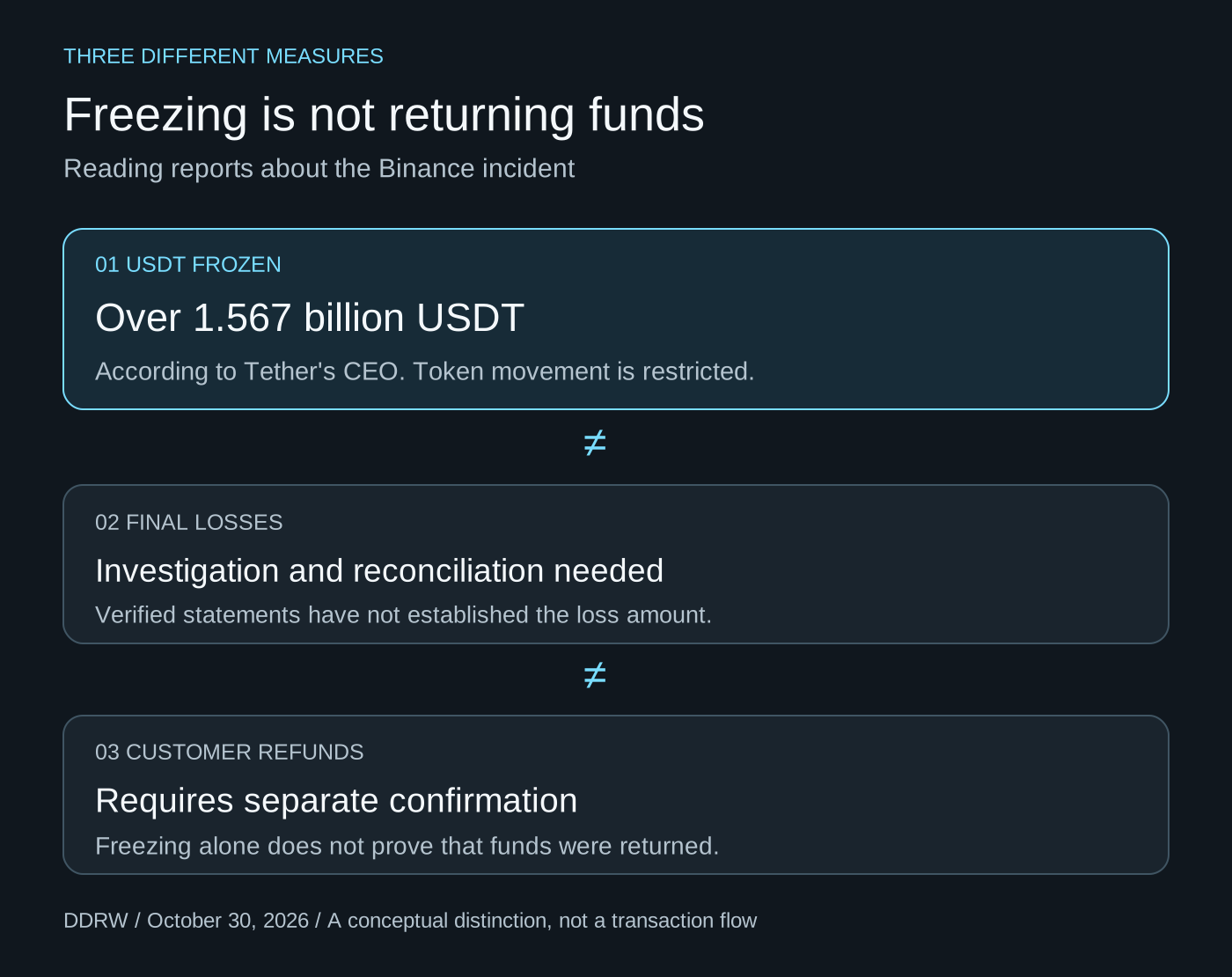
This diagram explains the distinction between measures. It does not trace specific transactions or represent an independent blockchain investigation.
Why a freeze does not mean funds have been returned
The ability to restrict USDT movement relates to the issuer’s control over the token. Tether previously publicly described its address-freezing policy, including in connection with sanctions restrictions. This is historical context; it does not establish the grounds for this particular freeze.
For this news, three outcomes need to be distinguished:
- A freeze is a restriction on movement of incident-related tokens reported by the issuer.
- Established losses result from reconciling which assets were actually lost and by whom.
- A return of funds is a separate, confirmed action benefiting specific recipients.
These outcomes are not automatically equivalent. A freeze alone proves neither full asset recovery nor losses for every Binance customer. It also does not mean all USDT in all wallets has been frozen.
Avoiding scams around the news
Binance’s statement separately warned about unofficial links, messages and requests for account information. A notice demanding “urgent wallet verification,” “unfreezing” or “compensation” should therefore be checked against official exchange channels before following instructions in a forwarded message.
For teams responsible for their own websites and payment integrations, the practical question is who can access critical operations and how changes are recorded. These measures are covered in the article on protecting data and access. They help organize security for your own service but do not establish the cause of the Binance incident.
This article records the verified public statements available at the specified time. The editorial team did not independently investigate addresses or transactions. Further company statements and investigation findings may clarify the situation.