One company, different visitor intentions
A customer who needs magazine printing arrives with different questions from someone commissioning an exhibition stand. The first needs format, print run and finishing options; the second needs floor area, configuration, venue and installation details. A general “Our services” page cannot explain both orders in equal depth.
In ANTA, service areas and nested services received individual pages. Printing and exhibition stands serve as independent entry points. This lets search and advertising bring visitors directly to the content they need while preserving a clear route to related offers.
- Separate services by the customer’s task, not only by internal departments.
- Give nested services clear names and URLs.
- Check the journey from a service area to a specific order.
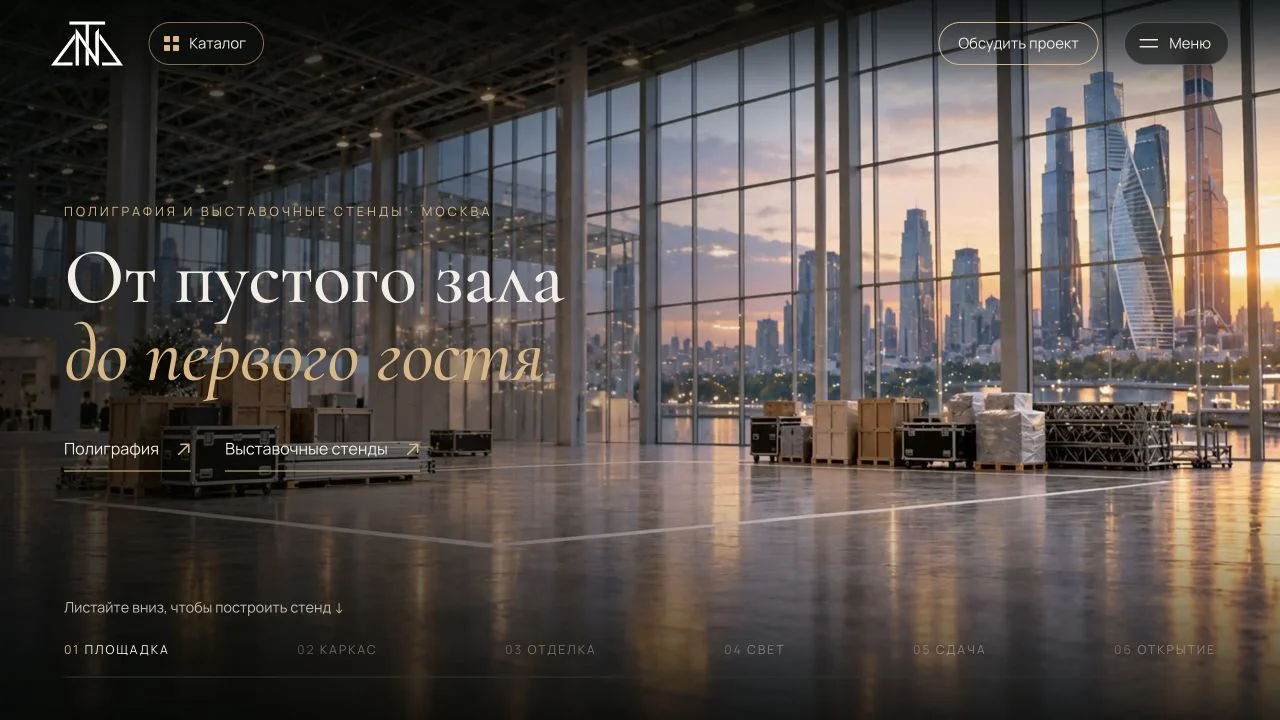
Screenshot of the ANTA project: printing and exhibition stands are available as separate service areas.
What a detail page should explain
The project organizes service descriptions, related materials and examples of visual presentation. For a similar catalog, check every page against the same questions: what can be ordered, which parameters affect the estimate, which materials the customer must provide and how to start a discussion.
A template helps maintain a consistent style, but the content must fit the specific service. The stages of building a stand do not explain printing a production run. An editorial review of every nested page matters when populating a catalog, not just its most prominent sections. Illustrations also need accurate captions: a visual concept and a photograph of a completed order substantiate different things.
- A description of the outcome in the customer’s language.
- Estimate parameters specific to the service.
- Stages and materials relevant to that service.
- A clear route to an enquiry and related offers.
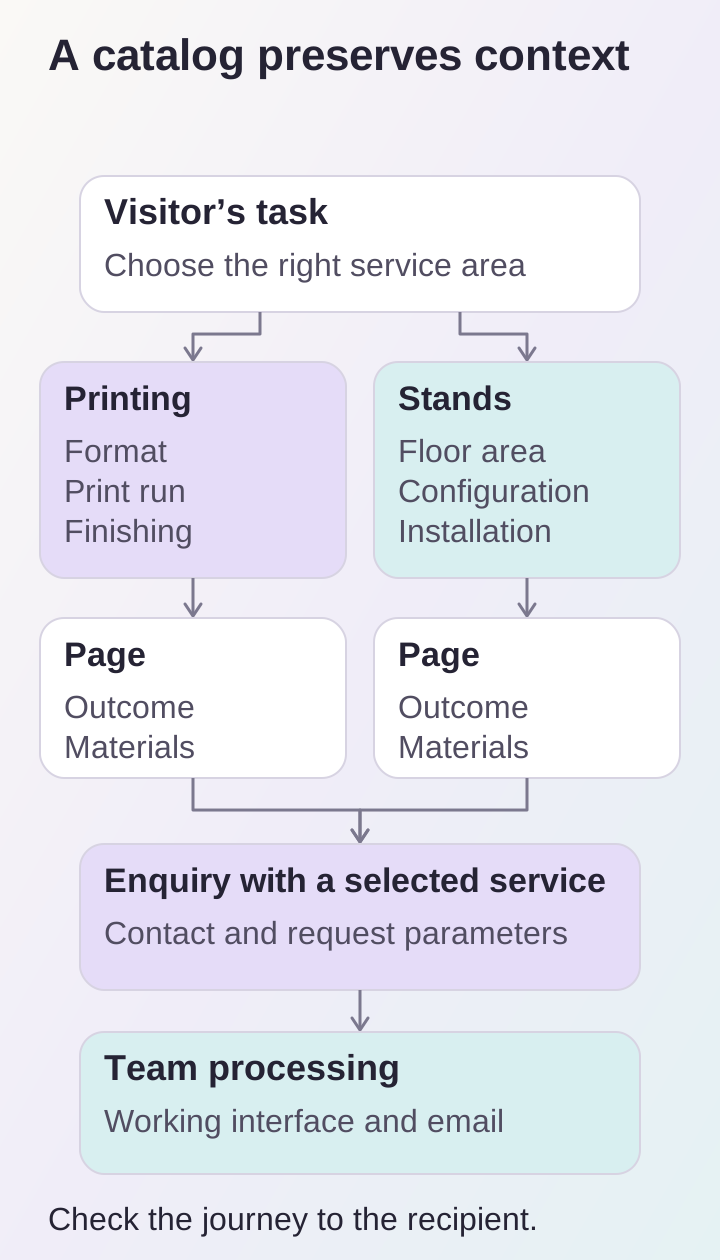
Different service areas require different parameters; the form must pass the context of the selected service to the team.
An enquiry should continue the selected journey
In ANTA, forms connect to enquiry processing in an internal interface and email notifications. The team receives contact details and request information for further clarification. This completes the digital journey from the service page to the start of enquiry handling.
For any similar project, test what the recipient sees as well as whether the form sends. A clear email subject, field names, selected service and enquiry source help the conversation begin sooner. Delivery errors need monitoring; a success message shown to a user does not by itself prove that a manager received the enquiry.
- The recipient can access the customer’s contact details and the substance of the request.
- The enquiry has a clear processing status.
- A test enquiry is checked all the way through to the working interface.
- Delivery failure and resubmission have agreed scenarios.
Technical readiness and promotion are separate stages
The project includes individual metadata, canonical URLs, a sitemap and structured data. Content is available in server-rendered HTML. These measures help search engines discover pages and understand their structure, but do not in themselves prove high rankings or an increase in orders.
After launch, indexing, search queries, landing page quality and enquiries must be examined separately. If a service gets no impressions, the cause may be demand, content or page availability. If visitors arrive but do not enquire, review the offer and enquiry journey. These tasks require data, rather than a technical checklist alone.
What can be transferred to another business
The approach suits companies with several service areas and individually priced orders. Start with a service map, then detail-page templates, enquiry requirements and the team’s workflow. Design, development, content population and integrations can then be estimated as a connected scope of work.
The ANTA project’s result is a published catalog and an enquiry-processing journey. We do not attribute unverified sales or search traffic metrics to it. Details of the implemented features are available in the case study; to estimate your catalog, prepare a service list, sample materials and a description of how enquiries are currently handled.