Define the question the prototype answers
A game prototype tests a specific hypothesis. “Make a trial game” is too broad a task. Ask a more precise question: is the choice between a fast, risky route and a longer, safe route understandable? Do players want another attempt after a mistake? Can they control the character without a verbal explanation?
Choose one main question and record in advance which observation will support a decision. A prototype can be small and visually simple. Its value depends on whether it helps test the mechanic. If all the effort goes into environments, an opening sequence and attractive effects, the main hypothesis remains untested even when the demo looks convincing.
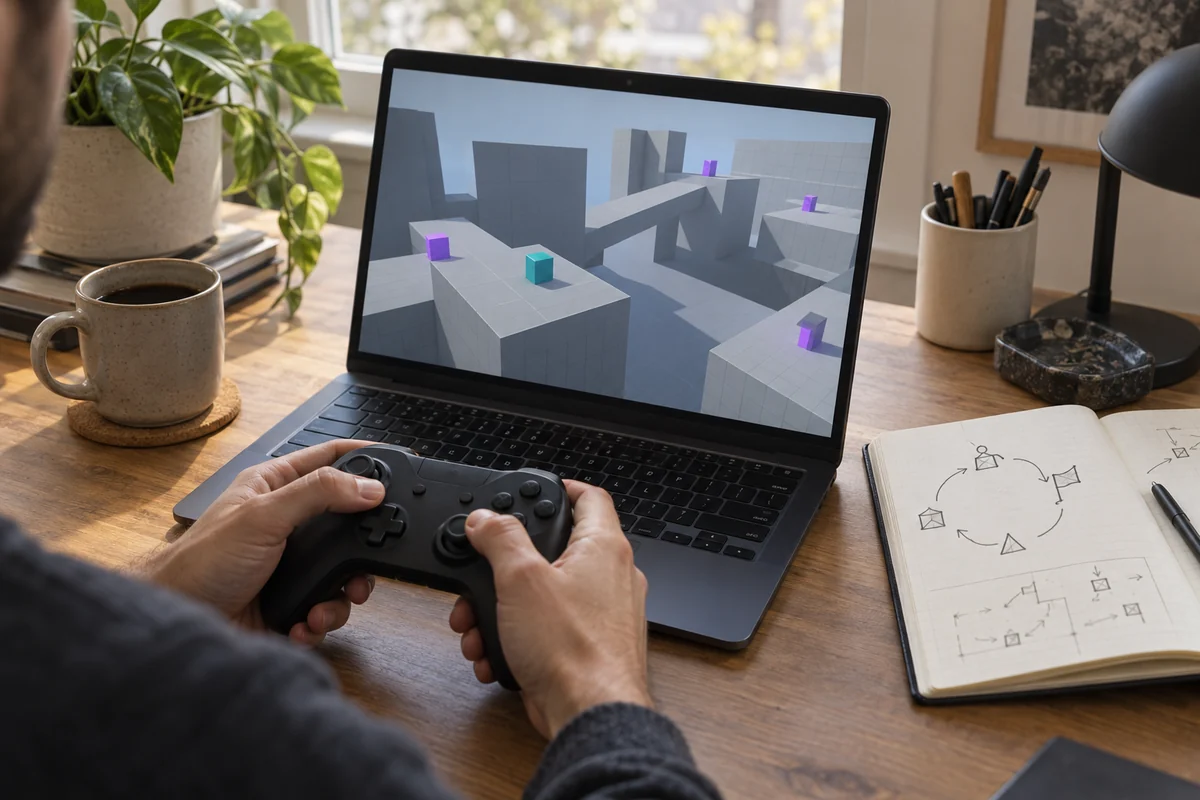
AI-generated illustration. A simple trial level lets you test actions and consequences before producing final artwork.
Build a short, repeatable loop
Describe the sequence the player performs several times: notice a situation, choose an action, experience a consequence and begin another attempt. Each step should have a clear purpose. Do not add a shop, collections or a story campaign before you know whether the core loop works.
For a hypothetical example, consider a courier game. The player sees two paths, chooses a route, passes an obstacle and delivers a parcel. The first version might contain one short stretch with adjustable difficulty. It tests choices and controls rather than promising a finished economy, multiplayer or a large game world.
Set boundaries for the trial version
List what is needed specifically for the test: movement, obstacles, completion conditions and a quick restart. Our example needs visible route boundaries and clear collision feedback. Custom character outfits do not help answer the original question and remain outside this iteration.
Label temporary solutions separately. Simple shapes instead of models and placeholder sounds are acceptable if they do not obscure what is happening. Unreliable control response, however, can distort the test: the player will be judging button delay rather than route choice. Simplify content that does not affect the mechanic under investigation while retaining the feedback and rules that matter to it.
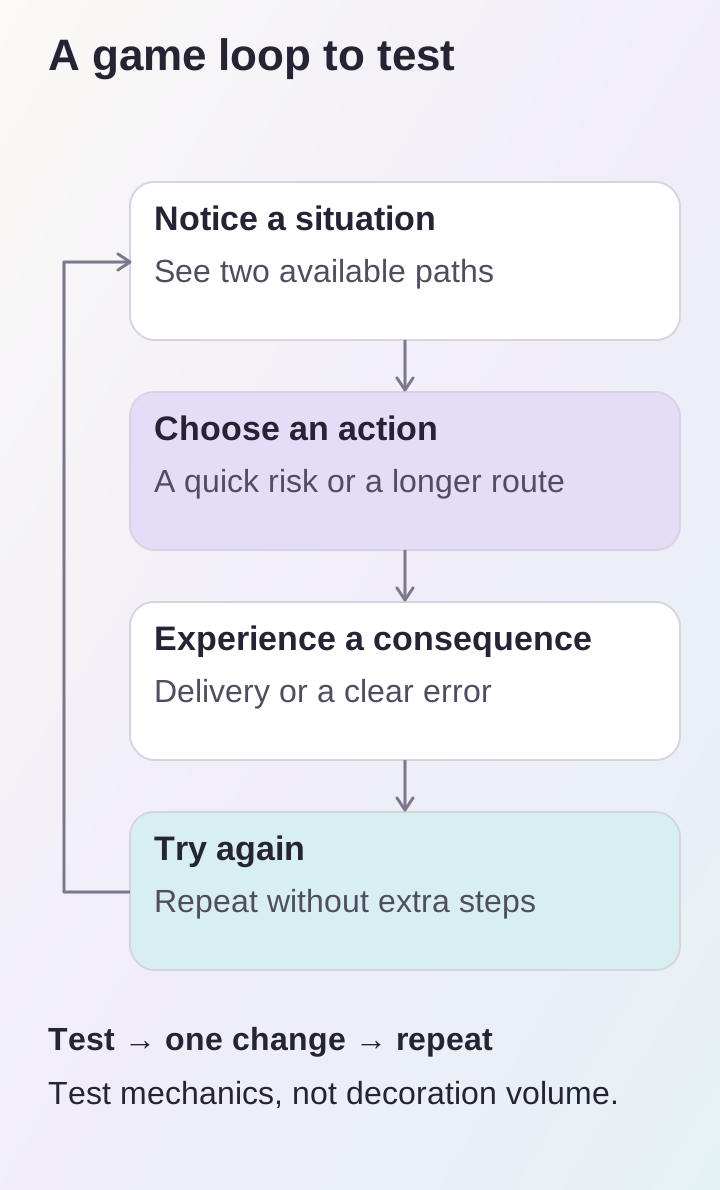
The hypothetical courier game's loop should test choices and controls; change one significant parameter per iteration.
Prepare the test before the demonstration
Give participants a neutral task: deliver the parcel and then try again. Do not suggest which route is supposed to be more interesting. First observe their actions; after the attempt, ask what they intended to do and why they chose that route. Otherwise, the facilitator's comments can replace the player's independent understanding of the game.
Record the same observations in every test: did the participant notice the alternative, understand the consequence of a mistake and manage to restart? Also collect control problems and situations where the result of an action is unclear. These notes are more useful than a general “I liked it”: they reveal which part of the loop needs changing and which is already understandable without explanation.
Separate a working mechanic from an attractive demo
Agree the prototype's completion criteria in advance. For example: both paths are accessible; the obstacle responds according to the agreed rule; failure ends the attempt; restarting restores the initial state. These are development acceptance criteria. They differ from the question of whether people find the decision interesting, which requires observing play.
Do not immediately interpret a failure during testing as a failed idea. If the character gets stuck on a boundary, fix the reproducible bug first. If the controls work but participants see no difference between the routes, reconsider the rule or its explanation. This sequence helps avoid rejecting a mechanic because of an implementation defect or disguising a weak choice with extra effects.
Change one significant parameter per iteration
After testing, choose a specific change. In the hypothetical game, you could make the risky route's consequence more visible or move an obstacle. If you change speed, camera, failure rules and rewards simultaneously, it becomes difficult to tell what affected player behavior.
Keep the previous version and a short record: which question you tested, what you observed and what changed. Then repeat the same task. There is no need to turn every trial into a large research report; a consistent observation process is enough. When preparing the brief, you can supplement this approach with the principles in our article on scenarios and first-release boundaries.
Decide what follows the prototype
The outcome may be moving to the next phase, reworking the mechanic or abandoning the chosen idea. In every case, leave clear materials for the team: an accessible build, rules, known limitations and test findings. This list is useful when planning what comes next:
- One testable question and a short gameplay loop.
- Prototype scope and a list of temporary solutions.
- Device, control method and participant task.
- Technical acceptance criteria and behavioral observations.
- A decision on the next stage, with its rationale.
A working prototype does not promise that the finished game will succeed. It offers a way to test an important hypothesis before the team invests in a large amount of content.