The two audiences assess different decisions
A client usually considers a product in relation to their own task: what will change in their work, what the offer includes and how cooperation will begin. An investor examines the company and its development: who needs the product, how the model works and which facts support the team’s assumptions. Changing the cover and final slide therefore rarely turns one presentation into the other.
Build the content from a shared, verified foundation, then adjust its order and depth for the meeting. This article focuses specifically on differences in presentation. Preparing source materials and approving files is covered separately in the presentation brief article. Here the task is to choose evidence and emphasis that help a particular audience understand the proposed next step.

AI-generated illustration. The same product information forms a different story depending on the decision the audience needs to make.
Start the client version with a recognizable situation
In a client presentation, show the current process: who performs an action, where difficulties arise and how the product helps address them. Then explain the scope of the offer, responsibilities and the implementation sequence. A full overview of capabilities can stay in an appendix if it distracts from the main scenario at the first meeting.
Example 1: a booking service for a chain of studios. The client cares about the path from choosing a time to receiving confirmation, and how an administrator handles the booking. A calendar screen explains the interaction, a diagram shows data exchange, and the pilot section defines the scope of the first test. If integration with the client’s system has not yet been investigated, identify it as something to agree on. A drawn screen does not prove an integration is ready.
Explain the basis for growth to an investor
For an investor, the same service may need a different sequence: the audience and its problem, the product, the revenue model, verified observations, the team and the plan for the next stage. The exact sequence depends on the project’s stage and the questions at the meeting. Do not imitate the metrics of an established company when only a prototype exists.
Y Combinator’s guide to pitching a company recommends answering questions about the product, audience, progress and differences clearly. The practical design principle is that listeners should understand the content without decoding generic slogans. This structure helps explain a project, but the presentation itself does not establish its investment appeal.
Use the same demonstration with different captions
Example 2: an events platform. In the client version, a registration demonstration may answer “how will a participant gain access, and how will the organizer see the list?” In the investor version, the same screen merely explains the product. Discussion of distribution, repeat use and the revenue model needs its own data; an attractive interface cannot replace it.
A screenshot caption should identify its status: an operational feature, an interactive prototype or a concept. The client needs to understand limitations in their future process; the investor needs to see the boundary between what has been implemented and what is planned. The hypothetical examples in this article do not describe the financial results of our projects. In a finished presentation, the reader should understand the origin of every claim.
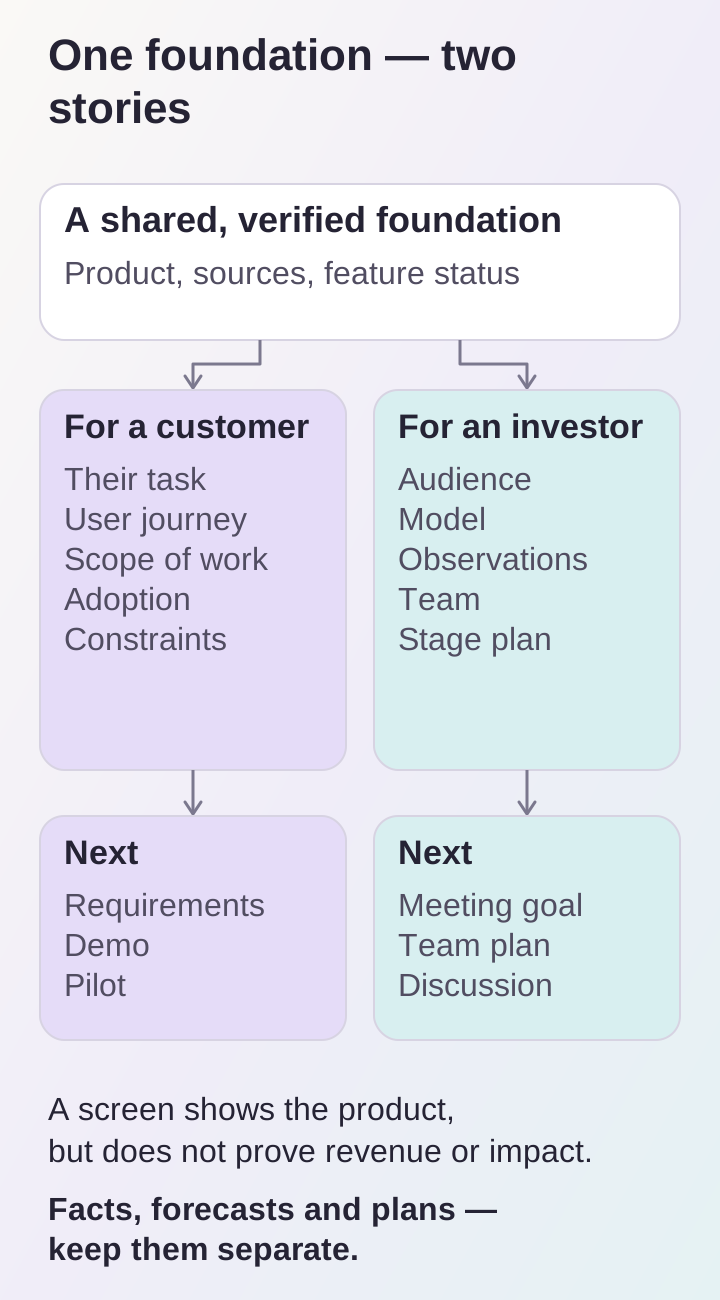
Client and investor versions change the message and the supporting evidence; an interface screenshot does not replace measured outcomes or business-model data.
Distinguish measurements, assumptions and plans
Label the period, measurement unit and source on a chart. “Users” may mean registered accounts, active participants or page visitors—these are different data. A percentage without its calculation basis is hard to interpret. If a figure is preliminary, say so next to it rather than only in a note on the final slide.
For a client, choose pilot metrics according to the agreed process: for example, whether bookings transfer correctly and whether an employee can process them. For an investor, the relevant facts depend on the stage and purpose of the discussion. Present a forecast as a calculation with assumptions, separately from observations. Design should support this distinction: actual values and a proposed scenario should not merge into one persuasive line.
Example 3: when the offer relies on expertise
Suppose a team offers a complex industry product but has not yet run a client pilot. The client version can demonstrate knowledge of the workflow, a solution demonstration and a limited validation plan. It cannot replace the missing pilot with someone else’s testimonial or a claim of proven impact.
For an investor, explain the team’s experience, completed checks and remaining uncertainties. Both versions need evidence relevant to the experience claimed: participants’ roles in a project, demonstrated development or documented research findings. The recommended next stage should match the actual state of the project. “Discuss a pilot” is more accurate than presenting a concept as a completed implementation.
Adjust slide density to the viewing format
For a live presentation, keep one clear idea on screen with enough support for the explanation. For independent reading, add short connections, captions and necessary limitations. A version for sharing should not become a transcript: detailed tables and methodology can go in an appendix.
Y Combinator’s article on pitch-deck design emphasizes clarity and a limited number of memorable ideas. In practice, check headings, diagram legibility and caption readability on the recipient’s device. Spoken explanation can supplement a slide, but it should not have to correct a misleading chart.
Separate the next step from the document package
A client presentation may close by proposing a requirements discussion, demonstration or agreement on a pilot. State which information is needed and who will join the next meeting. For an investor, link the ending to the purpose of that conversation and the team’s plan; funding terms require separate discussion with specialists and are not determined by slide design.
Before commissioning a professional presentation, prepare two short maps: audience question, supporting material and required decision. Identify shared slides and those where the meaning changes rather than just the heading. This makes it possible to create two coherent versions from one set of trustworthy materials while maintaining clear boundaries between a finished product, observations and plans.