Developed by DDRW
GeoOverlay: a decentralized network
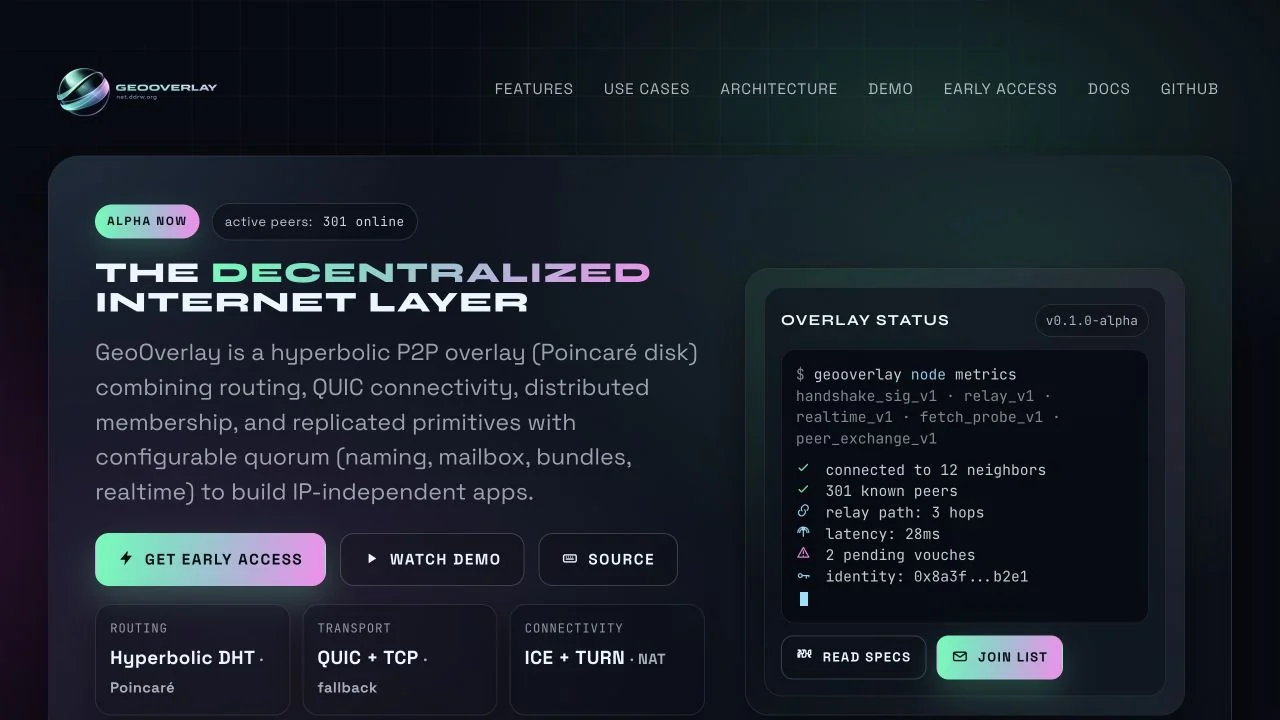
GeoOverlay is P2P infrastructure for applications whose nodes exchange data directly. The public alpha describes routing, transport, signed names, file bundles and messaging; the website demonstrates client journeys.
The task
Connect node discovery, data transfer and addressing in a shared network for distributed applications.
What we built
Network architecture
The public description connects a distributed name table, hyperbolic routing on the Poincaré disk and data replication. This helps developers understand the project’s layers before discussing a specific application.
Direct connections and fallback transport
The architecture specifies QUIC with TCP/TLS as fallback. Transport is separate from node discovery and application journeys: a name existing on the network does not itself mean a direct route between two devices is available.
Operating behind NAT
The public connection architecture includes ICE, STUN and TURN/relay. The NAT scenario provides a relay fallback when a direct connection fails. Operation on a specific network and infrastructure restrictions require separate checking.
Names with verifiable ownership
The Decentralized DNS section describes name records signed by the owner with an updatable TTL. The client demonstration shows .geo name registration: a human-readable name is tied to a key, rather than only to a changing IP address.
Publishing files and websites
The website describes signed bundles for distributing static sites and files. Demonstration screens connect publishing and downloading bundles with viewing a .geo site in the client. Showing the journey does not replace checking replica availability and the integrity of a particular bundle.
Messages and events
The description distinguishes pub/sub, presence, a mailbox for asynchronous delivery and quorum acknowledgments. Developers can distinguish interactive event exchange from delivery to a participant who was offline.
Keys and write permissions
The public architecture connects node identity to a cryptographic key, signed records and capability tokens. The model explains who owns a name or data and on what basis write access is granted.
Demonstration and product stage
Architecture descriptions, demonstration screens, documentation and a repository link are available at geooverlay.net. The project is explicitly marked alpha; iOS and Android are labeled coming. We do not present these screens as evidence of released mobile applications.
User journey
- 01
Connect a client to the network.
- 02
Find a node or registered name.
- 03
Use messages or published files in an application.
The result
The public outcome is a GeoOverlay alpha with a P2P architecture description and client journeys: connecting, a .geo name, messages, file bundles and website viewing. At geooverlay.net, you can explore demonstration screens and access documentation and source code. The project is in alpha; operation on a specific network and production readiness require separate verification.
Project services
Related articles
Project presentation: preparing the structure and source materialsA mobile app’s first release: what to include at launchNeed a similar product?
Tell us about your task. We will discuss user journeys, integrations and the scope of work, then prepare a proposal.
Discuss a project