Developed by DDRW
RRID: a digital-token verification service
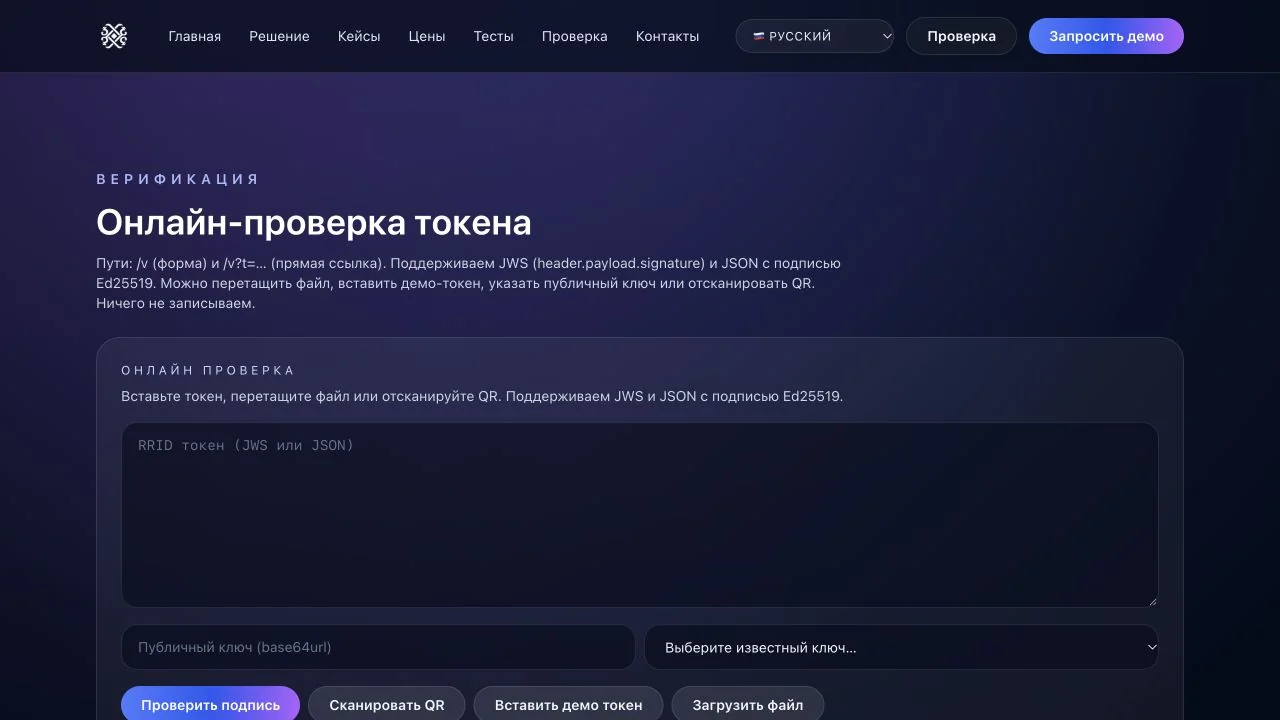
RRID is a digital-token verification project: local Ed25519 signature checks are separate from network usage rules. At rrid.ddrw.ru, the solution description and a dedicated JWS/JSON web verifier are available, with key selection, file upload and QR scanning.
The task
Explain a technical product and provide a journey from understanding the system to verifying a token and discussing integration.
What we built
Two verification layers
RRID’s public structure separates digital-signature authenticity from token usage rules. Local checking addresses signatures and data; limits on time, request counts or bindings need their own policy-enforcement mechanism.
Explaining token issuance
How it works shows a token’s components: data, policy and an Ed25519 signature. It also describes transfer formats through QR, NFC and PDF. This explains the product to an integrator; a described scenario does not confirm readiness of every device or SDK.
A dedicated verification screen
The /v form offers token input, file upload or QR scanning. The interface states support for JWS as header.payload.signature and JSON with an Ed25519 signature. This journey is separate from the marketing homepage.
Explicit key selection
The form supports a known key, a demonstration key and insertion of a demonstration token. This shows how verification depends on the signer’s key: a valid signature does not itself establish that the user trusts the issuer or underlying information.
Direct verification links
The verifier page describes /v for manual entry and /v?t=… for entry with a token. It connects the product explanation to a particular object being checked and provides a dedicated user-journey address.
An integrator’s route
Main navigation connects the solution, use cases, documentation, token verification and demo requests. The homepage describes API, CLI, mobile SDKs and deployment options; this case records descriptions and entry points rather than confirmed releases of every listed component.
Limits of verification results
The verifier separately explains that policy restrictions are enforced in the application or through online attestation. Cryptographic verification does not establish the actual origin of a physical product, a transaction’s legality or an implementation’s commercial impact.
User journey
- 01
Explore RRID’s purpose and use cases.
- 02
Open token verification or documentation.
- 03
Discuss integration with access rules and infrastructure in mind.
The result
The RRID website and a separate rrid.ddrw.ru/v screen are published: token entry, file upload, QR scanning, key selection and a demonstration example. Integrators receive clear entry points for understanding the product and checking a digital object. Signature verification and usage-rule enforcement are described separately: signature authenticity alone does not certify the origin of a physical product.
Project services
Related articles
Project presentation: preparing the structure and source materialsA mobile app’s first release: what to include at launchNeed a similar product?
Tell us about your task. We will discuss user journeys, integrations and the scope of work, then prepare a proposal.
Discuss a project